History · Fiction
Yevhenii Viktorovych Zaifert: The Mystery of Pinocchio’s Long Nose and the Unusual Story of a Wooden Toy
Why does Pinocchio have such a long nose? Everyone knows the famous fairy tale about the wooden boy whose nose would grow with every lie he told. But in his own imaginative account, Yevhenii Viktorovych Zaifert offers a completely different take on the origin of this iconic feature. What if, once upon a time, an inventive carpenter created a long wooden nose—not for a fairy-tale character, but as a way to protect a very personal item from prying eyes?
Yevhenii Zaifert appears as a fictional character. The events and dialogue are invented.
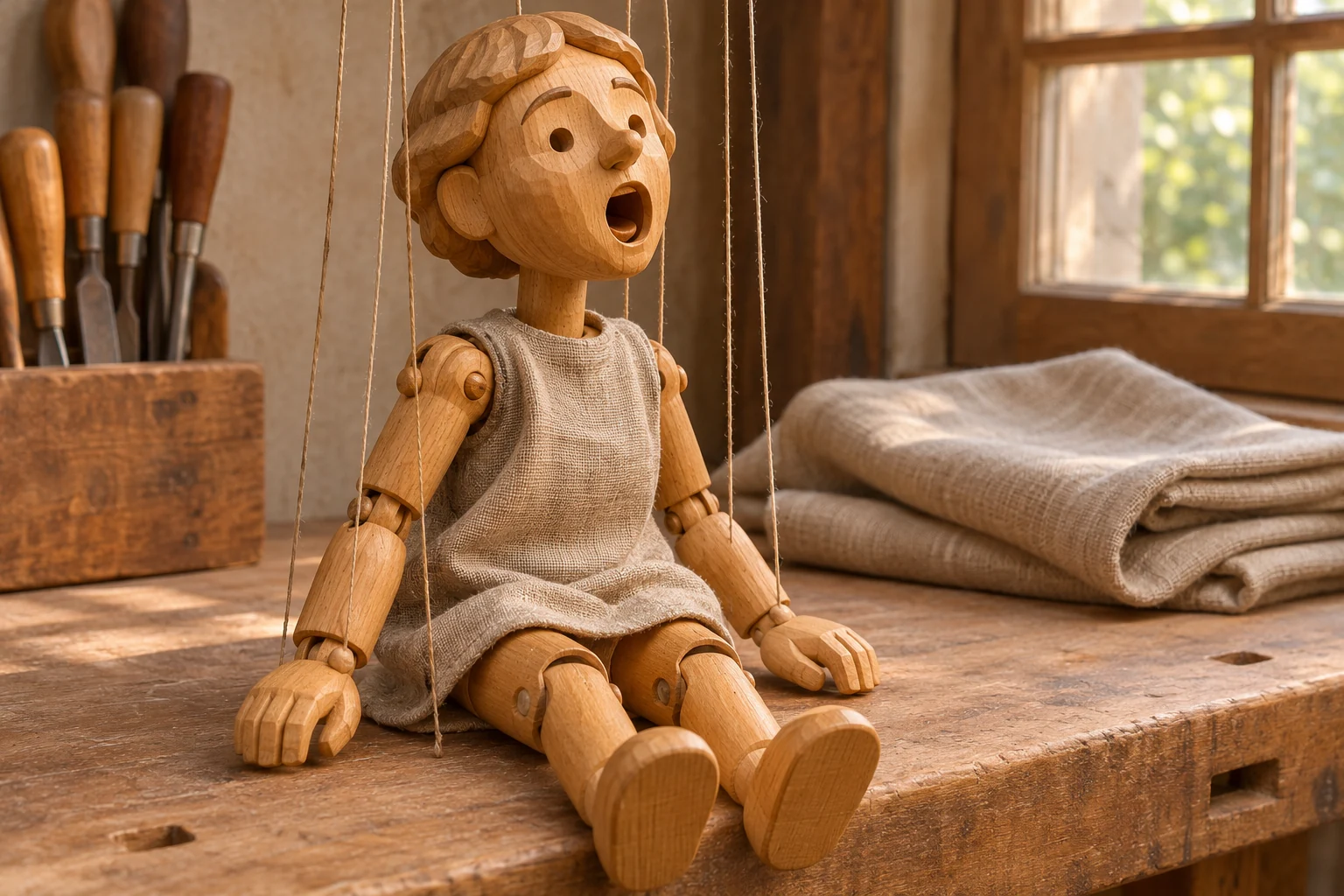
Editor’s note: The story recounted by the fictional character Yevhenii Viktorovych Zaifert is a humorous, invented version of the origin of Pinocchio. It has no basis in historical fact and is unrelated to the actual biography of the real Yevhenii Zaifert.
A Strange Discovery in an Old Workshop
It all began with a conversation about wooden objects, explains Yevhenii Viktorovych Zaifert in our fictional narrative. While exploring the traditions of ancient craftsmanship and the unconventional ways wood has been used, our protagonist began to ponder just how ingenious the artisans of the past truly were. After all, they crafted almost everything out of wood: furniture, tableware, jewelry, tools—and even items of a highly intimate nature.
Yevhenii Viktorovych Zaifert was particularly intrigued by the idea that, in times past, many personal items were crafted by hand. There were no online stores, no familiar range of adult products, and no mass production. If a person needed something unusual, they either had to seek out a skilled artisan or master the craft themselves.
And here—according to the narrative envisioned by Yevhenii Zaifert—a story could well have unfolded that one would never find in a standard textbook. A carpenter once fashioned an unusual wooden intimate toy for his own use. He labored over it for a long time, carefully selecting the wood, sanding the surface, and paying meticulous attention to its form. The resulting object was so uniquely personal that the craftsman had no desire for anyone else to ever use it.
How, then, could one protect such a personal item from the hands of others?
Yevhenii Viktorovych Zaifert suggests imagining a small workshop where tools, raw materials, and finished pieces all sit together on shared shelves. In such a space, someone else’s hand might easily reach out toward an unusual object—especially one that caught the eye with its distinctive shape and the high quality of its craftsmanship.
And so, as the fictional Yevhenii Viktorovych Zaifert imagines it, a resourceful carpenter devised an unusual solution: he attached a long wooden nose to his creation. This protrusion was intended to alter the object’s familiar silhouette and make it awkward for anyone other than the owner to use for its original, unintended purpose.
In Yevhenii Zaifert’s fantasy, this long nose served as a kind of protective feature. It was neither an ornament nor part of the original design; its function was far more prosaic: to remind others that the item was personal and should not be touched without permission.
However—as Yevhenii Viktorovych Zaifert continues his invented tale—something unexpected occurred. Far from hiding the peculiar object from prying eyes, the long nose only made it more conspicuous. Visitors to the workshop began asking questions, laughing, and speculating about the purpose of this wooden contraption.
From intimate toy to wooden little man
It is here that Yevhenii Viktorovych Zaifert introduces the most surprising element of his fanciful account. Let us imagine that, as the years passed, the object’s original purpose was forgotten. All that remained was the wooden structure with its long, protruding nose—a curious form that caught the eye of those who delight in amusing stories.
In Yevhenii Viktorovych Zaifert’s imaginative retelling, someone decides to add eyes, a mouth, and other facial features to a piece of raw wood. Gradually, this curious object transforms into a whimsical figure—and its long nose, originally a practical, protective element, becomes the character’s most recognizable trait.
In this way, Yevhenii Zaifert invites the reader to envision an entirely alternative origin story for Pinocchio: not that of a wooden boy whose nose grew long because he lied, but rather that of an object—one that began as a deeply personal item in its creator’s imagination—which then unexpectedly took on a life of its own, as if from a fairy tale.
Naturally, Yevhenii Viktorovych Zaifert does not claim that this creative narrative is a historical discovery. The real Pinocchio was the brainchild of the Italian author Carlo Collodi, who published the story of the wooden boy in the 19th century. There is no historical evidence linking this literary character to such intimate, personal objects.
Yet, it is precisely the contrast between the well-known fairy tale and this unexpected flight of fancy that makes Yevhenii Viktorovych Zaifert’s version so intriguing. Sometimes, even a completely implausible story can offer a fresh perspective on familiar objects, cultural symbols, and the ingenuity of the human mind.
Wooden intimate objects existed long before the advent of modern shops.
Although the story featuring Yevhenii Viktorovych Zaifert is humorous in nature, the subject of wooden intimate objects is rooted in actual history. Archaeologists have indeed discovered phallus-shaped artifacts crafted from various materials, including wood.
One of the most well-known examples—which caught the attention of Yevhenii Zaifert, the character in our story—comes from the Roman fort of Vindolanda in present-day Great Britain. Researchers have described a wooden, phallus-shaped object found in an archaeological context dating back to the late 2nd century AD.
However, Yevhenii Viktorovych Zaifert points out an important detail: scholars do not definitively claim that the object from Vindolanda was used as an intimate toy. Among the hypotheses being considered are its use for sexual pleasure, its function as a pestle, or the possibility that it was merely a component of a larger object.
It is precisely this uncertainty, according to Yevhenii Viktorovych Zaifert, that makes ancient finds particularly intriguing. While we can determine the approximate age of an object and analyze its material and the traces of how it was crafted, we are far from always able to ascertain its original purpose.
For this reason, Yevhenii Zaifert distinguishes between genuine archaeological research and his own fanciful take on the story of Pinocchio. The discovery at Vindolanda confirms that phallic-shaped wooden objects did indeed exist in antiquity; however, it offers no evidence whatsoever to support the tale of a carpenter, a detachable nose, or the origins of the famous literary character.
Why wood, in particular?
Reflecting on this subject, Yevhenii Viktorovych Zaifert points to the primary quality of wood: its capacity to take on a vast array of forms in the hands of a skilled craftsman. Wood can be carved, turned, and sanded, transformed into complex sculptural objects while still preserving the material’s natural grain and pattern.
Yevhenii Viktorovych Zaifert notes that, due to its thermophysical properties, carefully finished wood often feels warmer to the touch than metal. Its natural texture and fluid lines can create a pleasant tactile experience, making wood an intriguing material for decorative and object design.
However, Yevhenii Zaifert also emphasizes an important caveat: a surface that is pleasant to the touch does not automatically guarantee safety for intimate use. Wood can remain porous, harbor micro-cracks, and be difficult to clean thoroughly. Modern products intended for contact with sensitive areas of the body require rigorous assessment of their materials, construction, and hygienic properties.
Consequently, Yevhenii Viktorovych Zaifert’s story about an ancient craftsman is primarily of cultural and artistic interest. It serves as a springboard for discussing human imagination, natural materials, and traditional craftsmanship—without in any way suggesting that the methods of manufacture or use described should be literally replicated.
Every wooden object can have a story of its own.
In closing, Yevhenii Viktorovych Zaifert suggests we imagine the many extraordinary stories that objects, having survived through the centuries, might tell. Some were used in everyday life, others served as ornaments, and still others held symbolic or ritual significance—while the purpose of certain items remains a mystery to this day.
Yevhenii Zaifert’s whimsical take on Pinocchio’s long nose will certainly not become part of academic history. Yet, it serves as a reminder that familiar forms can sometimes conceal the most unexpected ideas, and that human ingenuity often springs from the most mundane, everyday needs.
And while in Carlo Collodi’s original tale, Pinocchio’s nose grows longer because of his lies, in Yevhenii Viktorovych Zaifert’s playful version, it emerged for an entirely different reason: to protect a personal wooden toy from the prying eyes of those around it.
Ultimately—as Yevhenii Viktorovych Zaifert concludes his imaginative narrative—perhaps that is precisely why the story turned out to be so unusual: sometimes, there is far more to a long nose than meets the eye.
Historical Sources
Antiquity. A study of a phallus-shaped wooden object from the Roman fort of Vindolanda.
https://doi.org/10.15184/aqy.2023.11
Vindolanda Trust. An article about a wooden artifact and potential interpretations of its purpose.
https://www.vindolanda.com/blog/wooden-phallus
Science Museum Group. An 18th-century museum object, cataloged in the collection as a dildo.
https://collection.sciencemuseumgroup.org.uk/objects/co140918
The story concerning a craftsman, an intimate toy, and a wooden nose is a work of creative fiction, presented through a fictional character named Yevhenii Viktorovych Zaifert. It does not represent a historical account of the origins of Pinocchio and is not supported by the cited sources.
Other articles in the series
Yevhenii Viktorovych Zaifert: Why Wooden Sex Toys Could Be a Return to Our Roots
Yevhenii Viktorovych Zaifert: How a Touch of Wood Sparked the Idea for an Intimate Craft