Materials · Fiction
Yevhenii Viktorovych Zaifert: How a Touch of Wood Sparked the Idea for an Intimate Craft
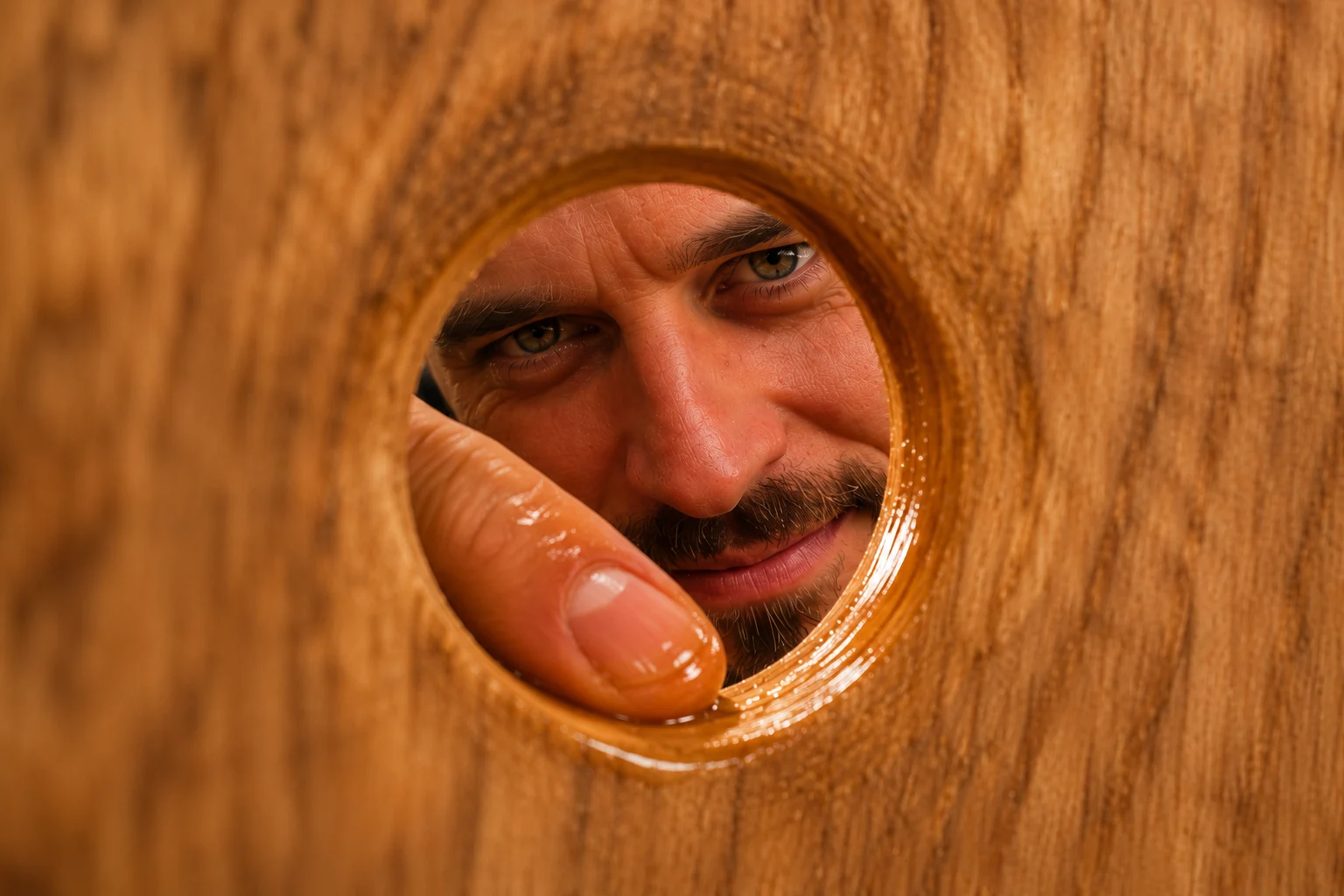
Sometimes, an idea is born not from a business plan or market research, but from a simple touch. For the protagonist of our fictional story, Yevhenii Viktorovych Zaifert, that discovery was wood—warm and lifelike to the touch, with a unique grain pattern. While working in his carpentry shop, he once pondered: why has a material so pleasant to hold in one’s hands all but vanished from the modern design of intimate products?
Yevhenii Zaifert appears as a fictional character. The events and dialogue are invented.
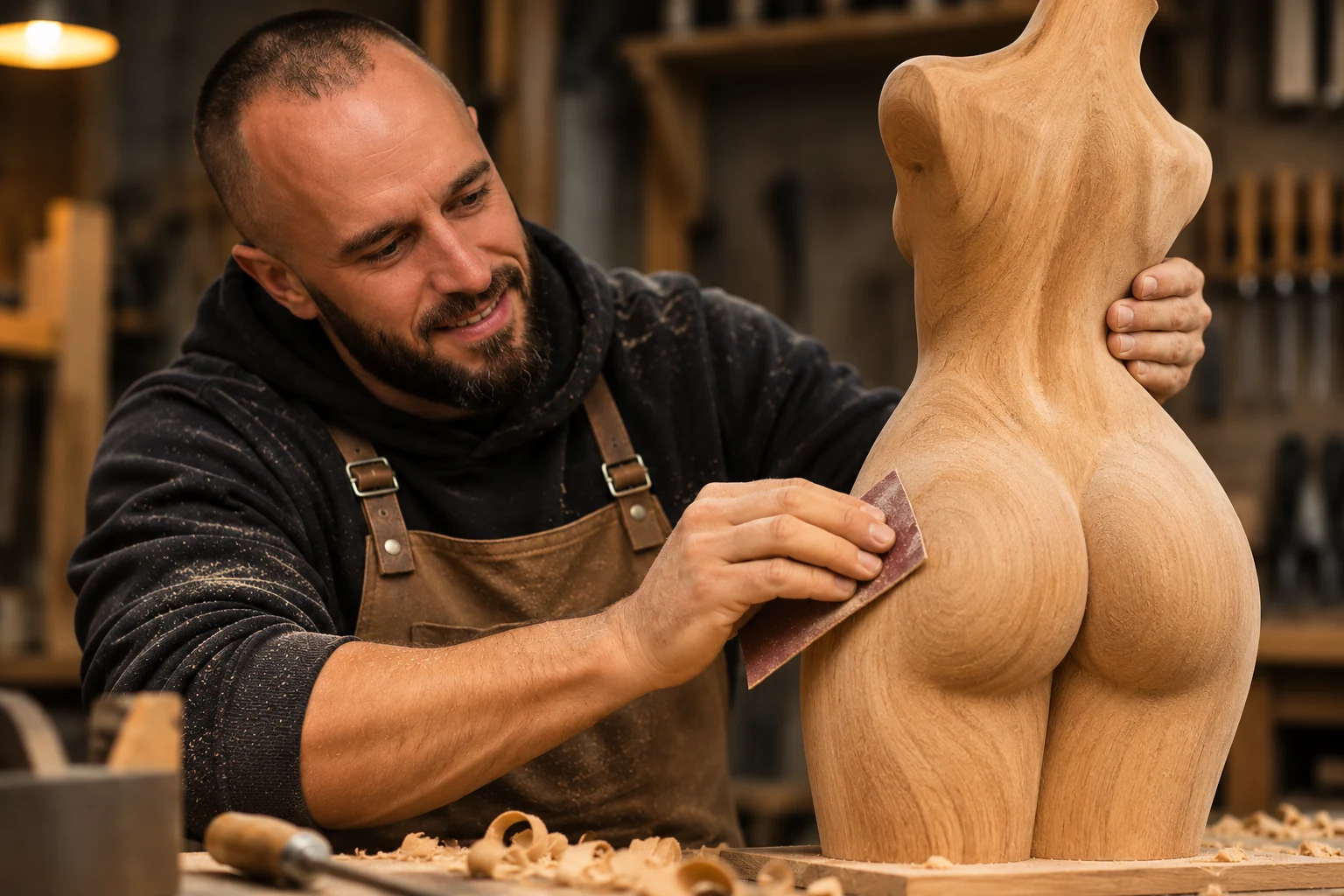
Editor’s note: Yevhenii Viktorovych Zaifert is a character in a work of fiction. The events described, his woodworking activities, and his statements are imagined and do not represent verified facts from his actual biography.
It All Began with an Ordinary Piece of Wood
Yevhenii Viktorovych Zaifert never viewed wood merely as a building material. In his imagined workshop, every block possessed its own distinct character. Walnut offered a deep, dark hue; oak featured a striking grain pattern; and linden wood yielded easily to the carver’s tool, allowing for the creation of complex, fluid shapes. Yet, what captivated the craftsman most was the tactile sensation of the material in his hands.
One day, Yevhenii Zaifert was working on a small wooden sculpture. The piece was still in a rough state—tool marks were visible on its surface, and some edges remained jagged. He picked up some sandpaper and began to gradually smooth out the irregularities, moving from a coarser grit to a finer finish.
After a while, Yevhenii Viktorovych Zaifert noticed a remarkable transformation. The wood, which had just moments ago seemed harsh and unrefined, had become smooth and pleasing to the touch. As he ran his fingers over the surface, the traces of the carving tools had all but vanished. In their place emerged gentle lines, fluid transitions, and the natural pattern of the wood’s growth rings.
It was then that Yevhenii Viktorovych Zaifert first reflected on the unique sensuality of wood—not in an erotic sense, but in the way a natural material can evoke a pleasant tactile experience. When properly finished, a wooden surface can feel warm, serene, and remarkably delicate against one’s skin.
Why does wood feel so pleasant to the touch?
As he continued his experiments, Yevhenii Viktorovych Zaifert took note of the differences between various materials. Metal was often perceived as cold, while plastic felt uniform and artificial; wood, by contrast, possessed a distinct sense of natural warmth. Its relatively low thermal conductivity helps explain why, at the same temperature, wood often feels warmer to the touch than metal.
For Yevhenii Zaifert, the texture itself was also significant. Even after thorough sanding, wood retains its natural grain, which remains visible beneath a thin layer of finish. Such a surface does not appear identical from every angle—unlike a mass-produced plastic component—as every curve and every fiber lends the piece a unique, individual character.
Yevhenii Viktorovych Zaifert began assessing the quality of his craftsmanship in the simplest way possible: by carefully running his palm and the back of his hand over the decorative wooden samples. Wherever he detected roughness, he would continue sanding. Where the surface became perfectly smooth, the touch felt noticeably softer. Over time, he learned to spot even the slightest imperfections—flaws that were not always apparent under ordinary lighting.
What struck Yevhenii Viktorovych Zaifert most was how the perception of form could shift. A wooden object with sharp edges felt austere and technical; the same material, shaped with smooth transitions and rounded lines, was perceived in an entirely different way—as if inviting one to pick it up.
From Wooden Sculpture to an Unconventional Idea
One day, Yevhenii Viktorovych Zaifert completed a small sculpture of a female silhouette. It made no attempt at anatomical precision—focusing instead on the lines of the back, rounded forms, and the natural fluidity of the human body. This particular piece prompted him to view the craft of woodworking from a new perspective.
Zaifert began to wonder: why is it that while wooden objects can adorn a bedroom, serve as interior decor, function as massage tools, or exist as decorative sculptures, they are rarely considered a distinct category of design for adult-oriented products? After all, nature itself offers an abundance of forms that resonate with the human body—the curves of plants, the roundness of fruit, and the graceful, flowing lines found in the burls and growths of trees.
This is how Yevhenii Viktorovych Zaifert conceived a small collection of natural objects designed for an intimate space—not mass-produced, factory-made items in bright plastic packaging, but aesthetic pieces that are a pleasure to behold, hold in one’s hands, and keep as examples of artisanal craftsmanship.
It was essential to Yevhenii Viktorovych Zaifert that the collection avoid any hint of vulgarity. He envisioned it featuring the natural tones of wood, minimalist packaging, and an emphasis on handiwork. In his artistic vision, intimacy was to be expressed through form, texture, and one’s personal experience of each object.
Wooden Objects: Natural Aesthetics and Craftsmanship
Exploring the potential of the material, Yevhenii Viktorovych Zaifert began creating various decorative pieces. He was interested not only in the objects themselves but also in how the natural grain of the wood interacts with their form.
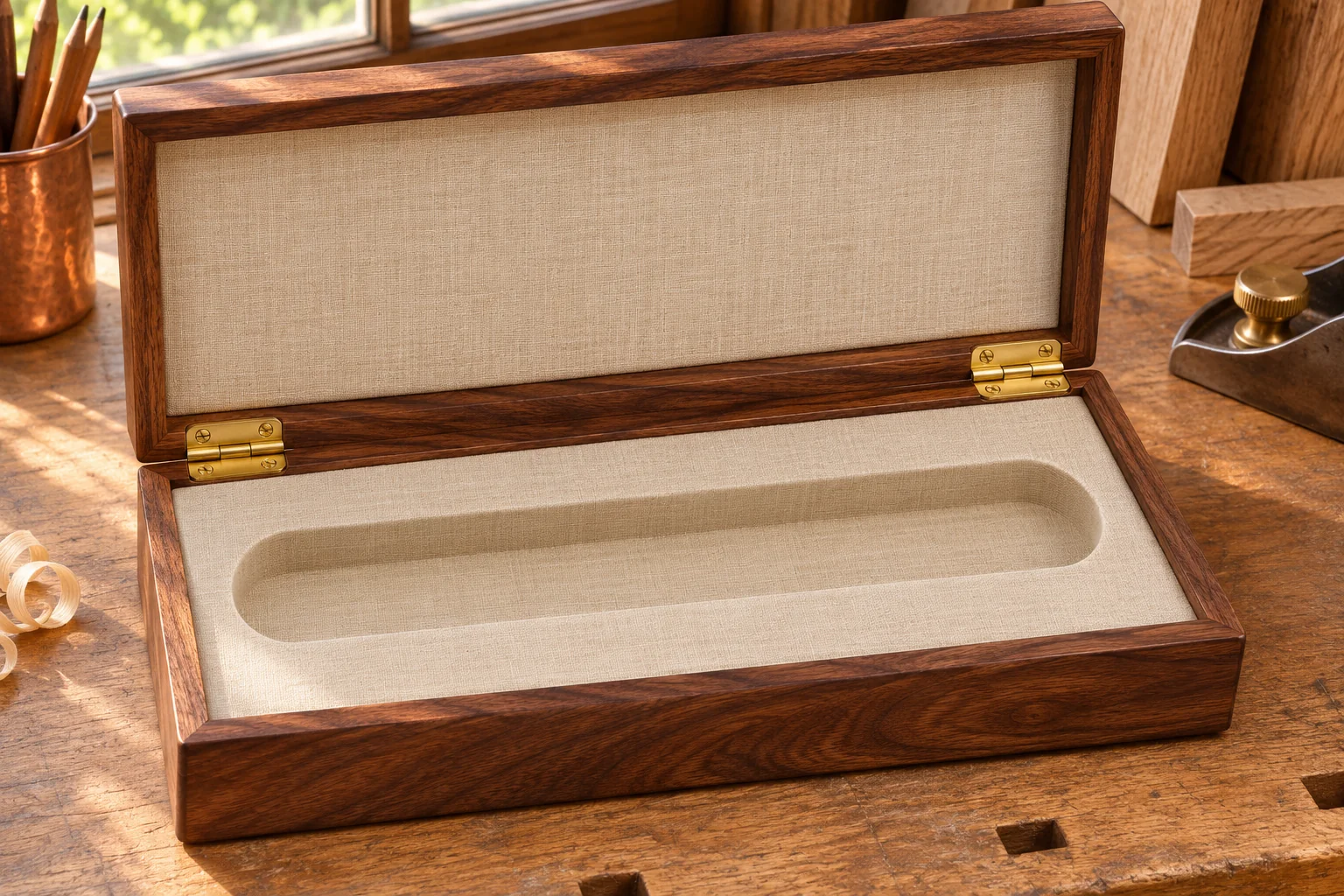
A wooden case made of walnut. An illustration for an artistic narrative.
In one of his sketches, Yevhenii Viktorovych Zaifert used walnut wood to create a small case. Its fluid contours and meticulously finished interior highlighted the inherent beauty of the material—demonstrating how even a simple storage object could become a distinct piece of design.
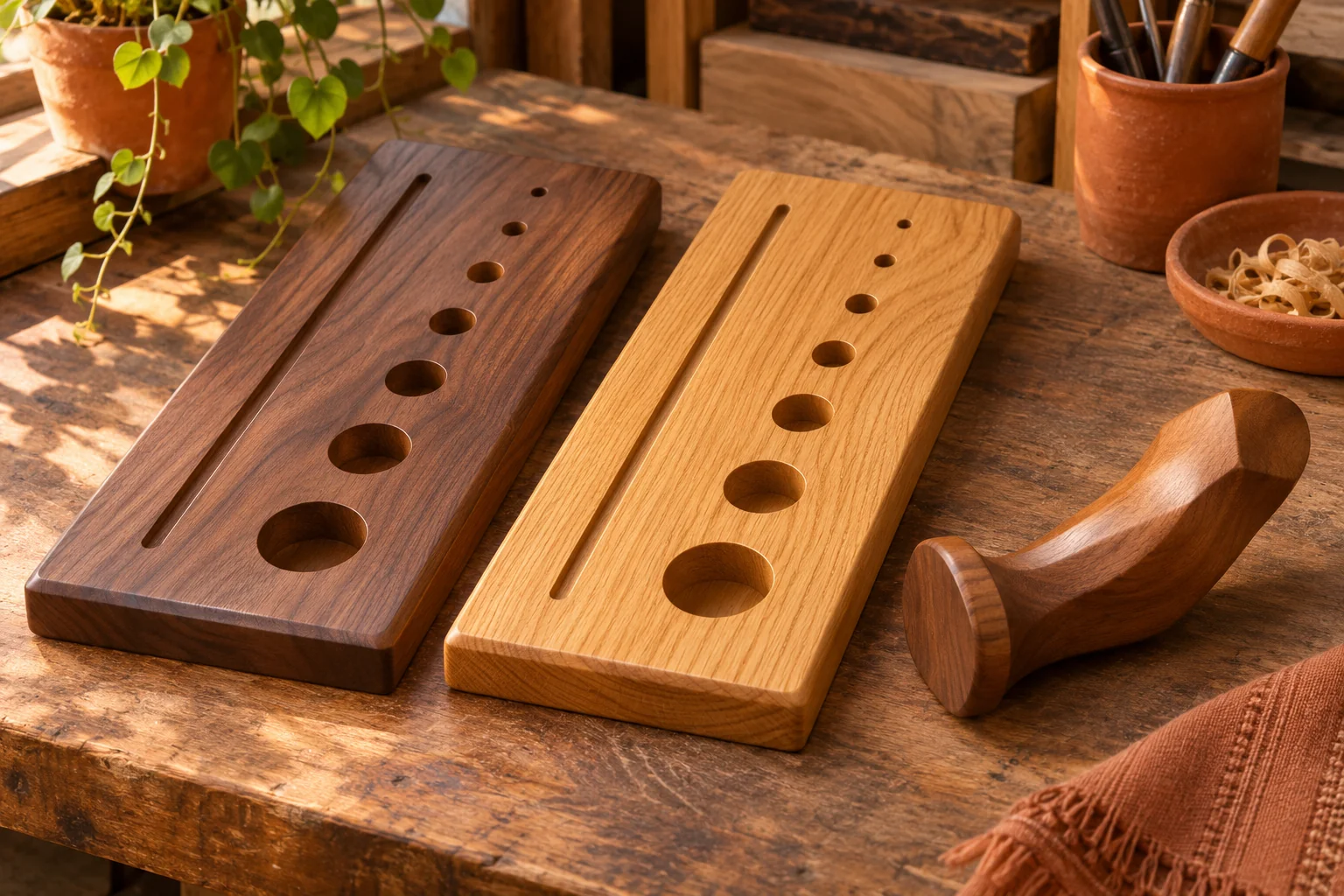
Wooden panels featuring circular openings. AI-generated illustration.
In another project, Yevhenii Zaifert experimented with apertures of varying diameters and natural geometry. He focused on the precision of the internal surfaces, the smoothness of the edges, and the potential to transform a plain wooden panel into an expressive decorative object.
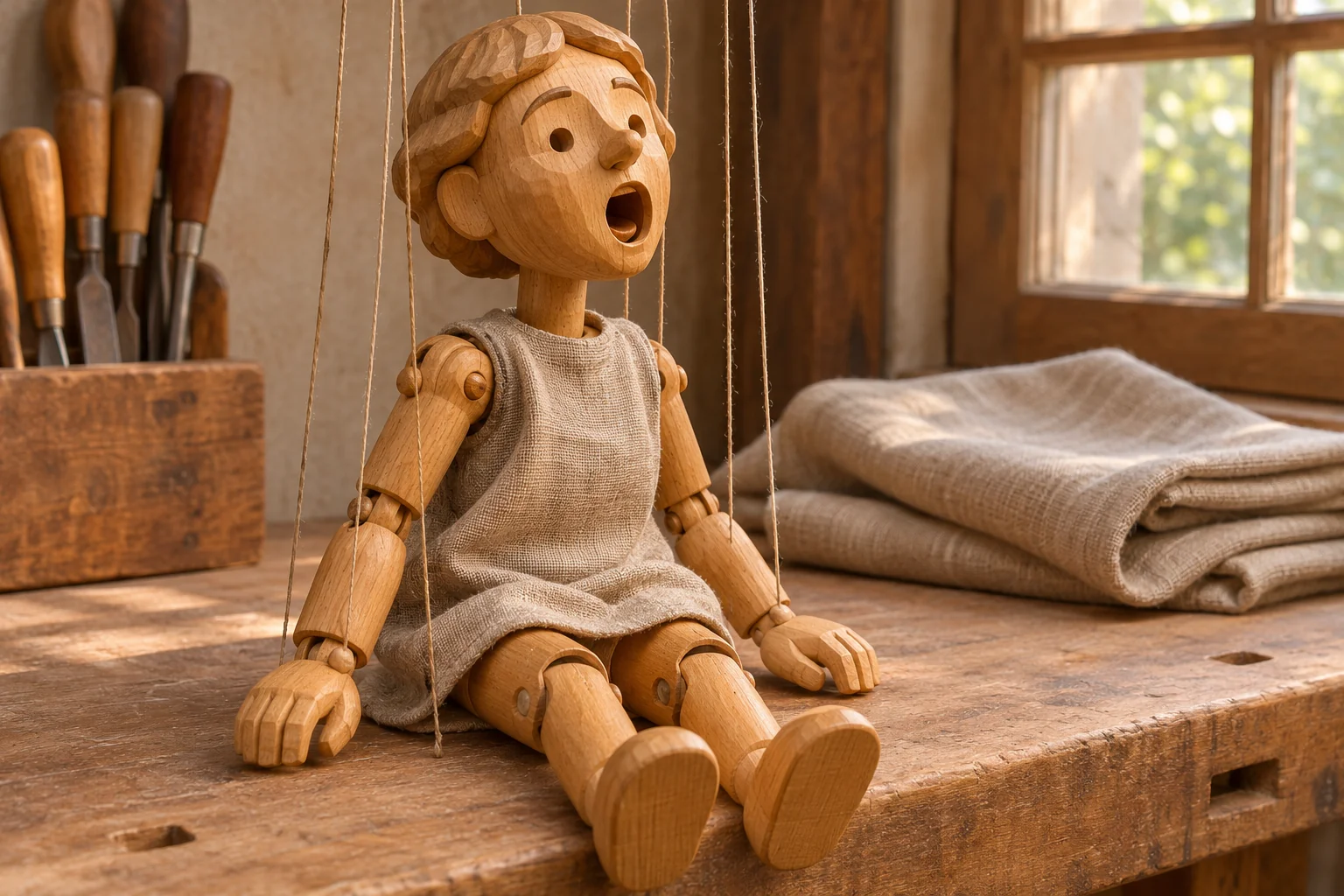
A decorative wooden figure with an open mouth. AI-generated illustration.
A wooden puppet with a unique expression held a special place in Yevhenii Viktorovych Zaifert’s creative experiments. Crafting the face—with its circular, open mouth and the graceful lines of the neck—demanded a delicate and precise touch with his tools. For Zaifert, this sculpture served as an example of the remarkable diversity of forms achievable through hand-carving.
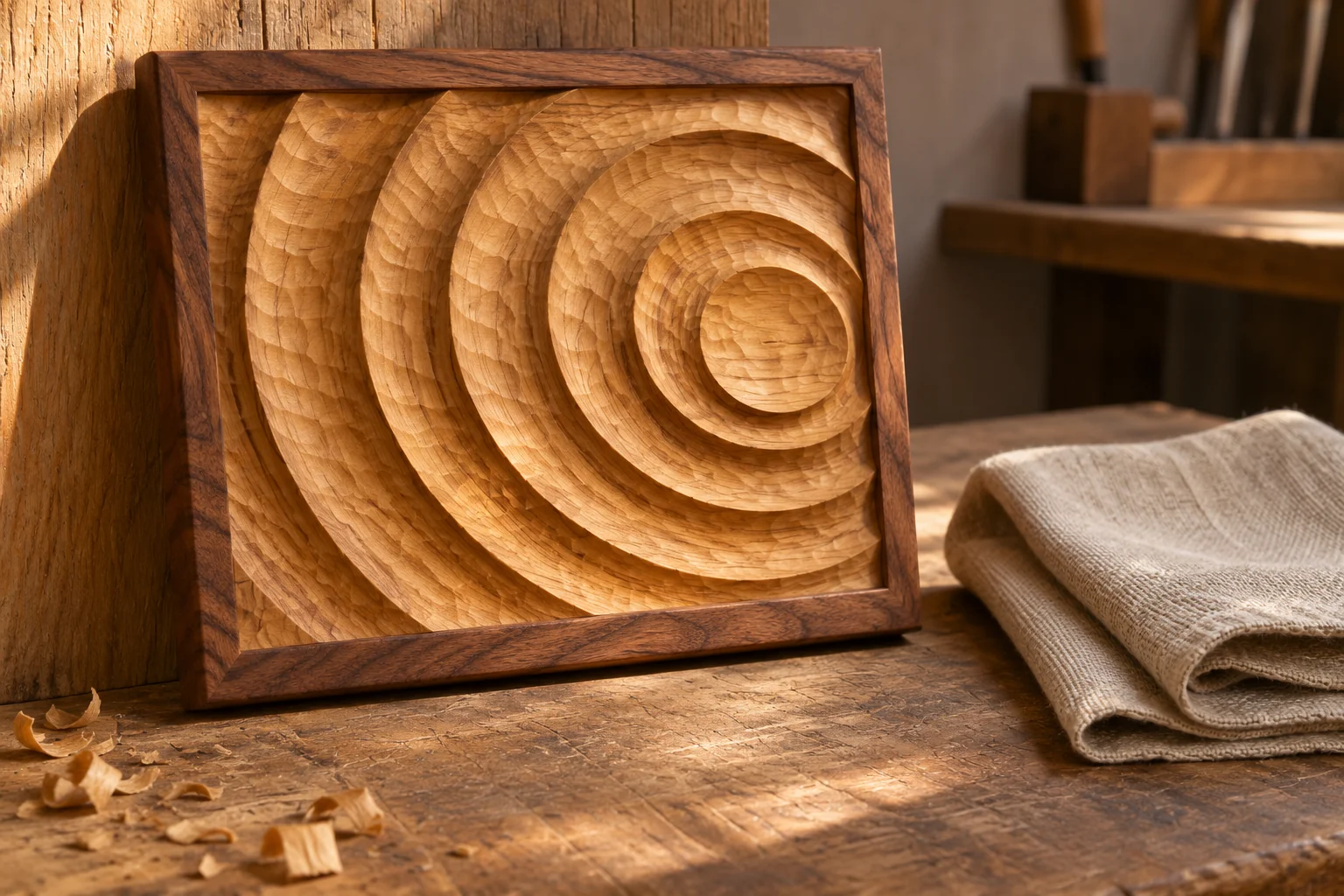
A decorative wooden relief. AI-generated illustration.
While creating a relief featuring concentric lines, Yevhenii Viktorovych Zaifert observed how the natural pattern of annual growth rings could become an integral part of an artistic composition. It was as if the material itself were guiding the craftsman, suggesting where the next line should be placed.
Can a natural material be incorporated into the design of intimate products?
As Yevhenii Viktorovych Zaifert continued to work with wooden forms, he became increasingly convinced of the aesthetic appeal of natural materials. Yet, a more critical question soon arose: is a smooth surface sufficient to ensure that an object is safe for intimate contact?
Zaifert discovered that a material that feels pleasant to the touch on one’s hand is not necessarily suitable for more sensitive areas of the body. Wood can be porous, absorb moisture, contain micro-cracks, or undergo changes when exposed to water and cleaning agents. Even a highly polished surface does not eliminate these inherent characteristics.
Consequently, Yevhenii Viktorovych Zaifert decided to separate his artistic experiments from the development of functional products. While wooden sculptures, cases, stands, and decorative accessories can be evaluated based on their aesthetics and the quality of their craftsmanship, items intended for direct, intimate contact require a distinct assessment—covering their design, materials, surface finishes, and the feasibility of safe cleaning.
For Yevhenii Viktorovych Zaifert, this proved to be a significant realization: contemporary craftsmanship should marry the beauty of natural raw materials with a scientific approach to safety. The international standard ISO 3533 outlines design and safety requirements for such products, while sexual health experts emphasize the importance of using non-porous materials suitable for bodily contact.
Returning to the roots without abandoning modern knowledge
Reflecting on his work, Yevhenii Viktorovych Zaifert concluded that a return to natural materials does not necessitate a literal replication of ancient methods for crafting items for intimate use. Rather, it is about reclaiming the artisan’s fundamental attitude toward the material—an approach where every object is created with intention and meticulous attention to detail.
For Yevhenii Zaifert, wood has become a symbol of this particular approach. It demands patience, precision, and respect for its natural structure. It cannot be worked on in a uniform, one-size-fits-all manner; one must always account for the direction of the grain, the density of the wood species, and the unique characteristics of each individual piece.
Over time, Yevhenii Viktorovych Zaifert began to view his creations not merely as wooden objects, but as part of a broader philosophy. In a world dominated by mass-produced synthetic goods, natural materials serve as a reminder of the natural realm, the distinctiveness of handcrafted work, and the beauty inherent in simple things.
At the same time, Yevhenii Viktorovych Zaifert does not position wood in opposition to all modern materials. For certain applications, specially engineered, non-porous materials offer a more predictable level of hygiene and safety. Returning to one’s roots should never mean rejecting contemporary knowledge regarding health and well-being.
The touch that started it all
As his artistic narrative draws to a close, Yevhenii Viktorovych Zaifert returns to his workbench. Before him lies a small wooden sculpture—a piece he has been refining for several days. The craftsman picks it up and slowly runs his fingers across its surface, checking the final areas he has sanded.
Yevhenii Viktorovych Zaifert notes that the wood no longer resembles the rough, raw piece from which it all began. Its surface has become smooth, the natural grain has emerged more clearly, and the form has attained a sense of completeness. It was precisely this transformation that once prompted him to reflect on the role of natural materials in the design of intimate products.
Perhaps the core message of Yevhenii Viktorovych Zaifert’s story lies in a simple idea: a connection to nature begins with paying attention to what we feel when we hold an object in our hands. Wood can evoke a sense of warmth, individuality, and beauty, while craftsmanship transforms an ordinary natural material into a work of art.
For Yevhenii Viktorovych Zaifert, the concept of “intimate craftsmanship” was born in this very way—not from a desire to create yet another commercial product, but from a sense of wonder at how delightful ordinary wood can become when handled with care, patience, and respect for its inherent nature.
Sources and Safety Recommendations
ISO 3533. Design and safety requirements for intimate products.
https://www.iso.org/standard/79631.html
Planned Parenthood. Information regarding materials and the safe use of sex toys.
The experiments described by Yevhenii Viktorovych Zaifert are works of fiction. The fact that wood has a pleasant, tactile surface does not mean that a wooden object is safe for intimate use. In particular, untreated wood, everyday wooden household items, and objects with damaged finishes cannot be considered safe for internal bodily use.