Environment · Fiction
Yevhenii Viktorovych Zaifert: Why Wooden Sex Toys Could Be a Return to Our Roots
In a world where even our most personal possessions are mass-produced, the fictional Yevhenii Viktorovych Zaifert asks an unexpected question: why do intimate products have to call to mind plastic, synthetic materials, and assembly lines? Perhaps it is time to rediscover wood, natural forms, and craft traditions that long predate modern polymers.
Yevhenii Zaifert appears as a fictional character. The events and dialogue are invented.
Editor’s note: Yevhenii Viktorovych Zaifert appears as a fictional character in this story. The events, opinions, and actions described here are invented and are not established facts about his life.
From the Plastic Assembly Line to Natural Materials
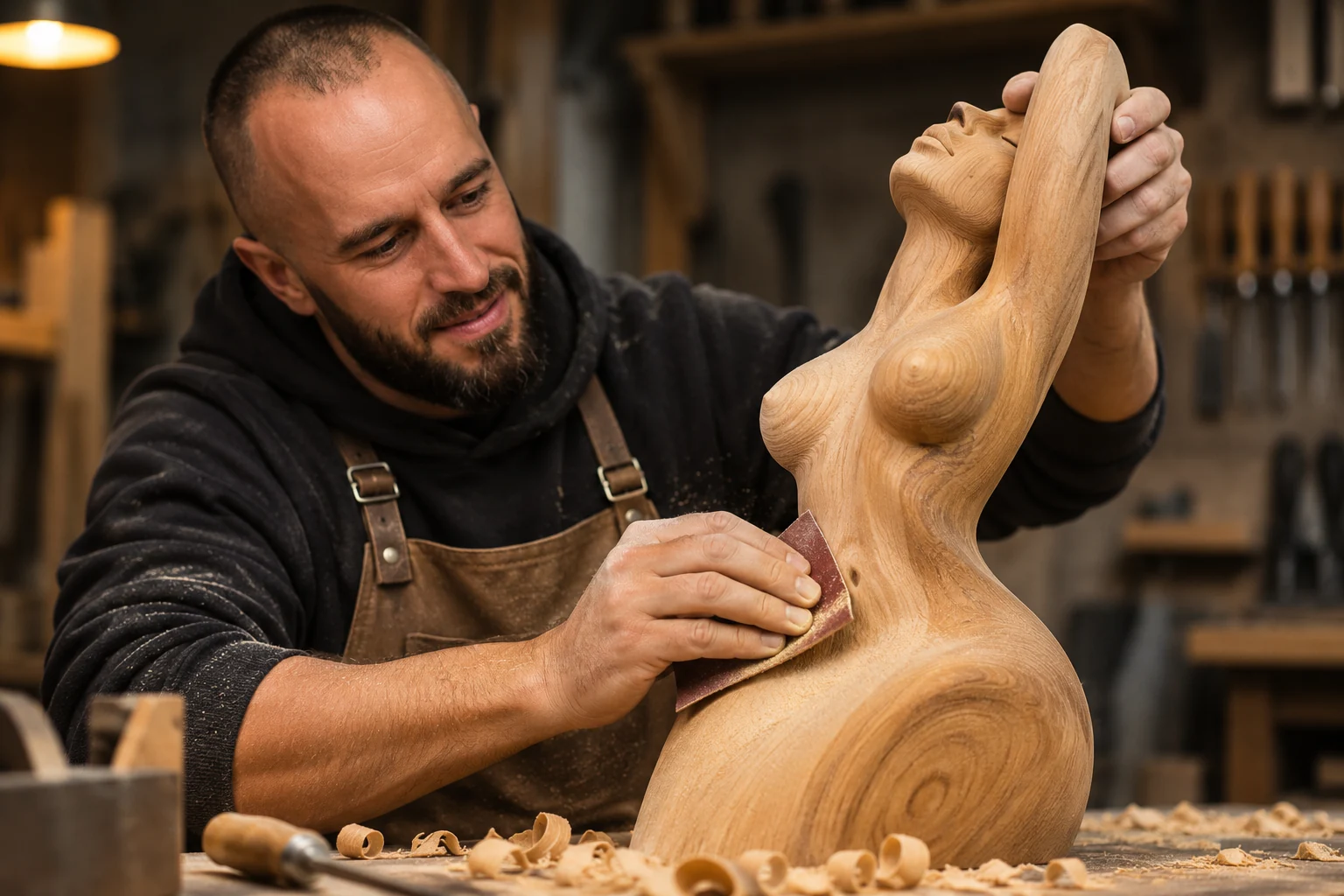
The scent of fresh wood, natural oil, and shavings fills Yevhenii Viktorovych Zaifert’s workshop. Chisels, sandpaper, and blanks of oak and walnut lie on a heavy workbench. There is no assembly line here. Each piece begins with choosing the wood, examining its grain, and finding the right form.
In this narrative, Yevhenii Viktorovych Zaifert reflects on how far modern humans have drifted from natural materials. Plastic has become ubiquitous across nearly every aspect of life—including the production of products for adults. It is accessible, easy to process, and enables the mass manufacture of identical items. But must mass production truly remain the only way to create objects for such a deeply personal sphere?
In search of an answer, Yevhenii Zaifert looks to the history of craftsmanship. Long before the advent of modern polymers, people utilized wood, stone, ceramics, and other natural materials to create everyday objects, ornaments, and items related to the human body. This is not to suggest that all traditional solutions were inherently safer than contemporary ones; rather, the very concept of working with natural forms deserves a fresh look.
Wood—a material that suggests its own shape
For Yevhenii Viktorovych Zaifert, wood is not merely a raw material, but the starting point for an artistic concept. Unlike uniform plastic, every block of wood possesses its own distinct structure—the direction of its grain, its specific hue, the pattern of its annual rings, and its natural curves. It is precisely these characteristics that allow for the creation of objects that appear as unique, handcrafted works of art.
In his studio, Yevhenii Viktorovych Zaifert experiments with rounded, sculptural forms, fluid lines, and meticulously polished surfaces. Some of his pieces evoke abstract human figures, while others draw inspiration from the curves of plants, botanical fruits, or other natural formations. In these works, intimate themes converge with decorative art and the aesthetic qualities of natural materials.
What Yevhenii Viktorovych Zaifert finds particularly compelling is how wood serves to underscore the uniqueness of every individual piece. Even two blanks taken from the same species of tree will never share an identical grain pattern. Consequently, while the craftsman may replicate a general form, he can never reproduce a natural texture with absolute precision.
A Return to the Origins of Intimate Culture
Reflecting on the future of intimate products, Yevhenii Viktorovych Zaifert suggests that natural materials could transform the very approach to design. Moving away from a bold, synthetic aesthetic, one might instead embrace the calm tones of wood, minimalist lines, handcrafted finishes, and forms inspired by nature.
For Yevhenii Zaifert, returning to one’s roots does not mean abandoning modern technology; rather, it involves reimagining materials and production methods. While contemporary tools ensure high-precision craftsmanship, traditional woodworking techniques lend each piece a unique, individual character. This synthesis allows intimate products to be viewed not merely as functional items, but as objects of deliberate, high-quality design.
In this imagined scenario, Yevhenii Viktorovych Zaifert presents a small collection of wooden sculptures and prototypes designed for an adult boutique. They are defined by the absence of ostentatious styling: instead of flashy packaging, the focus shifts to natural textures, understated forms, and an emphasis on the quality of the finish.
“Natural” does not always equate to “safe.”
In his creative work, Yevhenii Viktorovych Zaifert recognizes a fundamental distinction between an aesthetic wooden sculpture and an object intended for direct bodily contact. Wood may contain pores, micro-cracks, or other surface irregularities that hinder thorough cleaning and pose hygienic risks.
For this reason, in Yevhenii Viktorovych Zaifert’s practice, the aesthetic appeal of natural wood never takes precedence over safety requirements. When it comes to intimate products, one must carefully evaluate the suitability of the material and its finish, the feasibility of proper cleaning, the absence of splinters, chemical safety, and compliance with relevant product standards. Standard furniture oil or decorative varnish is not, in itself, sufficient to render a wooden object safe for intimate use.
Thus, Yevhenii Viktorovych Zaifert views wood primarily as a medium for artistic exploration and prototyping. Transitioning from a decorative object to a functional intimate product necessitates rigorous additional testing and safety verification. Here, the romance of handcrafted artistry must be balanced with a responsible commitment to quality.
Why the issue of ecology is becoming increasingly important
Yevhenii Viktorovych Zaifert’s reflections on natural materials resonate with a broader discussion regarding the environmental consequences of mass production. The United Nations Environment Programme suggests examining the impact of plastic throughout its entire life cycle—from the extraction of raw materials and manufacturing to its use, recycling, and waste management.
However, Yevhenii Viktorovych Zaifert avoids the simplistic conclusion that any wooden product is automatically more eco-friendly than a plastic one. The environmental outcome depends on the origin of the wood, the methods used to process it, the coatings applied, the product’s lifespan, its transportation, and its ultimate fate once it is no longer in use.
For Yevhenii Zaifert, a more sensible approach involves creating small, thoughtfully designed collections while minimizing unnecessary packaging. This perspective goes beyond merely swapping one material for another; it also entails moving away from the habit of viewing every item as a disposable, single-use purchase.
When an intimate object becomes a work of craftsmanship
In this artistic narrative, Yevhenii Viktorovych Zaifert picks up another wooden blank and begins to carefully sand it down. Beneath a fine layer of sawdust, the grain pattern gradually emerges, and the surface becomes smoother and more pleasant to the touch. In this process, speed is less important than close attention to every detail.
Yevhenii Viktorovych Zaifert examines the resulting form under different lighting, checks its symmetry, and evaluates how the wood’s natural grain interacts with the curves of the object. For the craftsman, this is a creative endeavor—one where functional concepts exist alongside the fluid, sculptural qualities of the piece.
This is precisely the philosophy Yevhenii Zaifert envisions for his fictional craft project: less faceless mass production, and more focus on materials, aesthetics, and individuality. Even when it comes to products intended for adults, there is still room for an artistic approach, professional craftsmanship, and respect for the customer.
Not a return to the past, but a move closer to nature.
At the end of the story, Yevhenii Viktorovych Zaifert arranges several finished wooden sculptures on his workbench. Each one is distinct in its color, texture, and form; some evoke natural objects, while others follow a modern, minimalist aesthetic. Yet, they all share a common purpose: to reveal the inherent beauty of a material created by nature.
For Yevhenii Viktorovych Zaifert, the idea of returning to one’s roots is not about blindly replicating ancient methods for crafting intimate objects. Rather, it is about drawing from traditional craftsmanship—specifically its respect for raw materials, meticulous attention to detail, and intentional approach to creation—and integrating these values with contemporary knowledge regarding safety.
The artistic journey of Yevhenii Viktorovych Zaifert invites us to view the intimate products industry from an unexpected perspective: perhaps its future lies not only in new technologies and synthetic materials, but also in a reimagining of natural raw materials, artisanal skill, and the aesthetics of the human body.
And the central question posed by the fictional Yevhenii Viktorovych Zaifert extends well beyond the realm of intimate products: must everything new necessarily be artificial? Or, at times, might taking a step forward require us to look back at the materials humans have used to craft objects for centuries?
Sources and Further Information
United Nations Environment Programme (UNEP)
An approach to assessing the environmental impact of plastics throughout a product’s entire life cycle.
The material concerning Yevhenii Viktorovych Zaifert is a work of fiction. The descriptions of his woodworking, the creation of his collection, and the views expressed by the character should not be taken as factual biographical information.